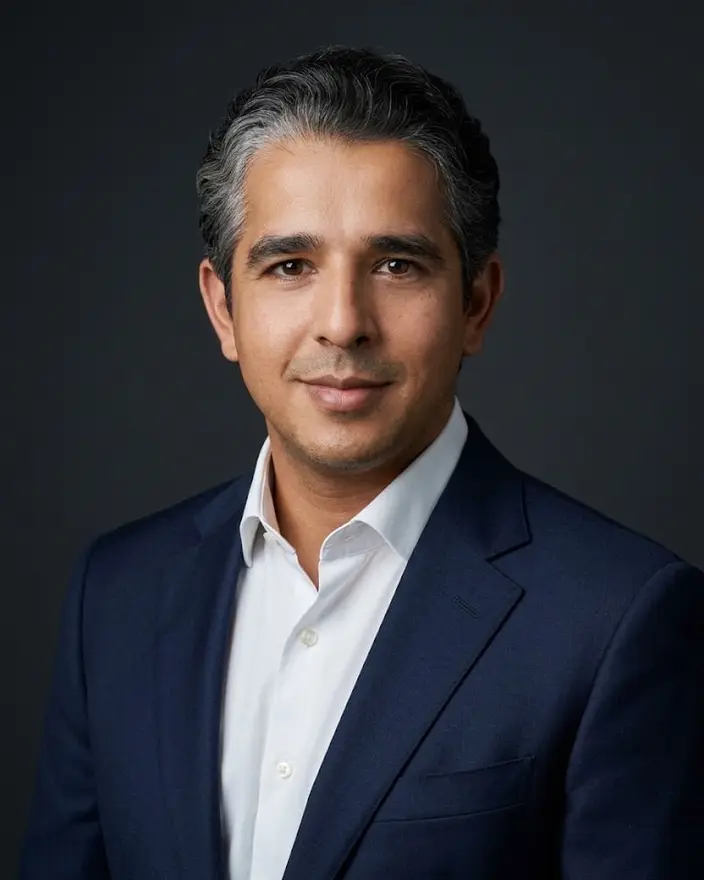
Israel Cerda de la Garza is a partner at G2 Investment Banking and leads the investment banking practice from Monterrey. He joined the firm in 2012, worked on multiple financial and strategic advisory engagements for emerging companies and became a partner in 2018. Since then he has led private capital and debt raises as well as mergers and acquisitions for founders seeking to structure sound transactions to scale their businesses.
Since 2015 he has been general partner of G2 Momentum Capital, the group’s venture capital fund, which invests in pre-seed and seed companies in fintech, health, insurance, blockchain, SaaS and enterprise solutions. He is a partner at G2 Fintech Fund and a member of its investment committee, where he takes part in the strategic and financial evaluation of dozens of opportunities each year. He is co-founder and general partner of G2 Credit Platform, the group’s private credit vehicle.
Before G2 he was a financial planning analyst at IOS Offices and Senior Financial Planning Analyst at Cervecería Cuauhtémoc Moctezuma (Heineken Mexico), where he consolidated his analytical training in a corporate environment.
He holds a degree in financial management from Tecnológico de Monterrey, a Master of Finance from the Schulich School of Business at York University and an MBA from IPADE Business School, where he was co-president of the Finance and Banking Club. He completed further training in mergers and acquisitions at EBS Universität für Wirtschaft und Recht.
His combined experience in consulting, venture capital and corporate finance allows him to read a transaction from both sides of the table: the founder who needs capital and the committee that decides whether to invest it.
The Brazilian embedded insurer combined equity with subordinated debt that counts as regulatory capital before SUSEP; it is the only venture debt structure in the sector this period and a reference for fast-growing carriers.
An incumbent insurance group co-leads the round of an AI distribution platform for SME health brokers that already operates at breakeven; the signal for Mexico lies in the channel, not the licence.
Less than a year after its Series B, the Brazilian individual-life MGA raises growth capital with BRL 307 million of annualised premiums and 11,000 brokers; in our reading, the price is set by distribution, not by the balance sheet.
DHL Express renews 20% of its Mexican fleet with group resources; it is not a capital raise, but it sets the standard of investment in last-mile assets against which independent operators get financed.
Patria’s first venture investment in Colombia funds a rent-to-own platform that has already sold a portfolio to an institutional investor; in our reading, that precedent is worth more than any projection.
The Brazilian freight marketplace structures a BRL 150 million (USD 28 million) receivables fund with XP, BTG Pactual and Polígono Capital to scale credit for the carriers operating on Fretebras.
BBVA Spark adds USD 40 million in Colombia to the USD 60 million already committed to Tuhabi in Mexico; in our reading, prior profitability and inventory as collateral explain why a bank scales the relationship to USD 100 million.
A trust vehicle, a committed tranche in Colombian pesos and an optional tranche backed by CMBS; in our reading, a replicable template for platforms holding residential inventory in Mexico.
A B2B2C travel insurance MGA with more than four million insured raises its first round with a partial sale by the founders and opens in Argentina; Mexico is not among the announced markets.
The design-to-construction platform for homebuilders raised primary capital from growth funds and corporates in the building materials chain; a reference for what the market pays for vertical software with measurable results in margin and construction time.
Ten months after a down internal round and two USD 200 million bank facilities, Kavak returns to the market with growth capital and a first month of consolidated profitability as its calling card.
An AI assistant that handles buyers and tenants over WhatsApp raises USD 16 million; in our reading, the capital pays for the channel and the conversion metric, not the model architecture.
The Argentine project management platform for real estate developers, artificial intelligence-native and run through WhatsApp, raised capital to consolidate its operation in Mexico and launch financial products; a reading of how vertical construction software is financed in the region.
Mercado Libre placed USD 750 million of senior unsecured notes due 2033 after a quarter with USD 421 million of net income, and six months later announced a USD 4.6 billion investment in Mexico for 2026.
Mexico’s fully digital auto insurer raises capital from a global fund and from the venture arm of a US carrier; in our reading, the regulatory licence weighed more than the app.
The global fleet operator for mobility platforms raises USD 250 million led by Mubadala for autonomous vehicle infrastructure; it is present in Latin America through Kovi in Brazil and the sources do not mention Mexico.
The iBuyer placed zero-coupon convertible debt at a 35% premium, covered dilution up to twice the share price with a capped call and repurchased 5% of its share capital the same day; a corporate financing reference for real estate inventory models in Mexico.
The Brazilian on-demand marketplace for professional drivers and cargo assistants reaches BRL 310 million in twelve months with Bicycle Capital, Monashees and Caravela; round type and valuation were not disclosed.
An AI operating system for insurance brokerages, with 3,000 brokerages two years from founding, raises a USD 8 million seed co-led by Andreessen Horowitz and Kaszek; distribution software is concentrating the sector’s capital.
The digital health insurer for SMEs, licensed as a specialised health insurer and reinsured by RGA, adds USD 21 million and reaches USD 46 million raised since 2018; the licence and renewal above 95% explain the price.
BBVA Spark provides USD 25 million to a fintech that advances payments to Mexican carriers; sources differ on whether it is a credit line or financing, and that difference matters to anyone preparing a similar deal.
Uber takes an equity stake in Chilean motorcycle lender Galgo, with Mexico as the first market; the amount was not disclosed, but the company describes it as the largest single equity investment in its history.
The Brazilian electric motorcycle subscription platform with battery swapping raises USD 45 million to develop a hybrid ethanol-electric motorcycle and manufacture in Manaus; the valuation was not disclosed.
A USD 250 million commitment, rather than an equity round closed at a valuation, funds VEMO’s electric fleet, charging network and driver leasing; the instrument says as much as the amount.
Insurtech capital in the region doubled in 2025 and concentrates in life and health, incumbents enter as strategic investors, and no acquisition of a Mexican insurtech has yet been announced.
Kavak returned to the market with USD 300 million after a year of profitability, cross-border freight technology buys capabilities, and credit lines from Goldman Sachs, HSBC and Cometa fund fleets and receivables.
Venture capital has halved since 2021, transactional platforms fund themselves with bank lines of up to USD 60 million and the regional leader buys instead of raising.
By Israel Cerda de la Garza · · 6 min read
Use of cookies
We use essential cookies so the site works and, only with your consent, anonymous analytics to understand which content is useful.